
The DNA Learning Center (DNALC) at Cold Spring Harbor Laboratory has released DNA Subway 2.0, a comprehensive update to its globally recognized genomics education platform. DNA Subway 2.0 is the first bioinformatics toolkit engineered specifically for mobile interfaces, allowing students, educators, and researchers to analyze DNA sequences directly on smartphones and tablets.
Bioinformatics—the data science of biology—has traditionally relied on desktop computers to process complex algorithms. DNA Subway 2.0 removes this hardware dependency by offering a fully touch-optimized interface for rigorous scientific workflows, including DNA barcoding, gene annotation, and phylogenetic tree building.
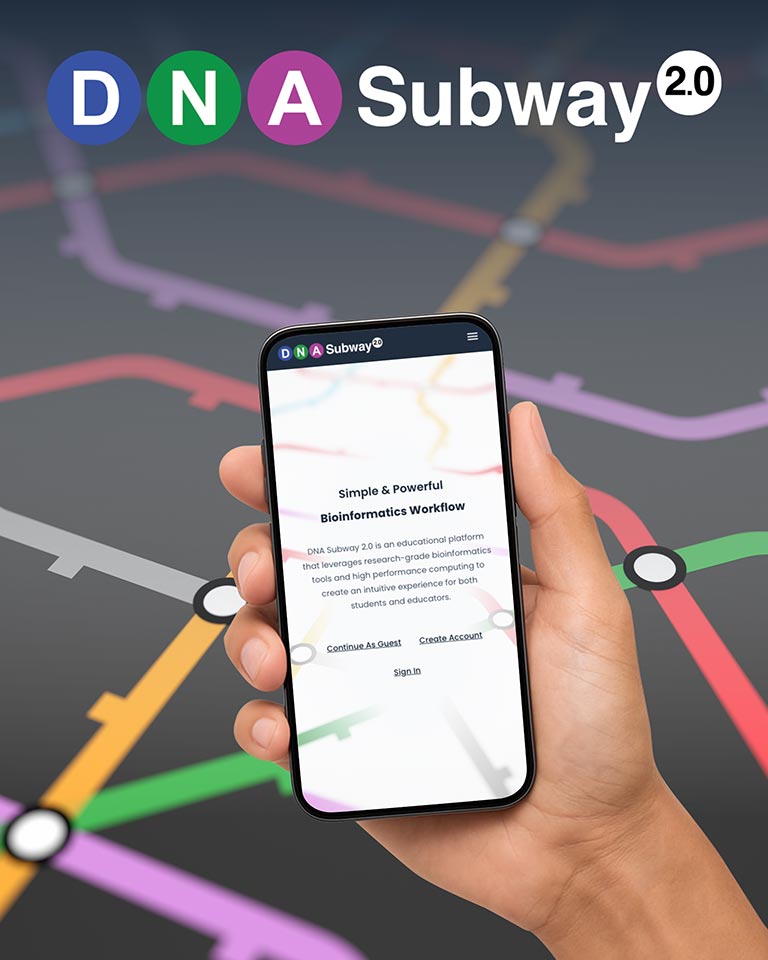
Imagine analyzing DNA sequences from dozens of animals or plants and mapping them out in a family tree, all with your phone. That’s what DNA Subway 2.0 delivers.
“We set out to build the first bioinformatics toolkit capable of running strictly on mobile devices,” said Jason Williams, Assistant Director of External Collaborations at the DNALC. “By removing the tether to desktop computers and moving the processing power to the cloud, we can democratize access to high-level genomic analysis for students in any classroom or field setting.”
In addition to mobile-first design, the new platform features expanded support for Nanopore sequencing, offering specialized workflows for DNA barcoding and small genome analysis. The system is built on the National Science Foundation’s Jetstream2 infrastructure, which provides the necessary cloud power for faster processing and greater reliability regardless of the device used.
Written by: Communications Department | publicaffairs@cshl.edu | 516-367-8455