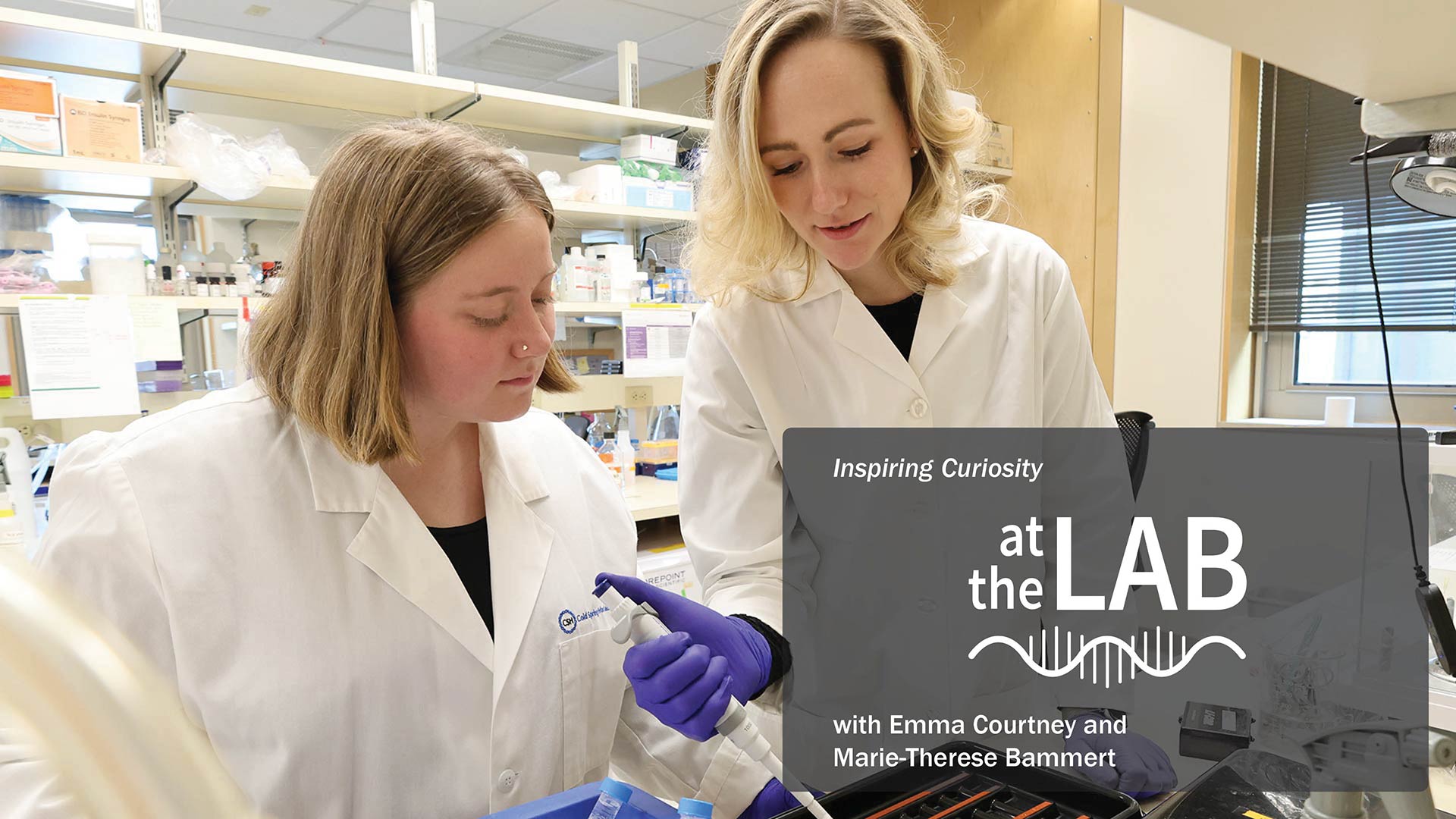

Behind every scientific discovery are researchers asking bold questions and navigating the unknown. In this episode, we explore the realities of life as an early career scientist through a conversation with Reese Bammert, a postdoctoral fellow, and Emma Courtney, a graduate student, both at Cold Spring Harbor Laboratory. Together, they discuss what fuels curiosity, how setbacks become learning moments, and why resilience is just as essential as technical knowledge.
From mapping the healthy endometrium to understanding how infections may influence breast cancer, Bammert and Courtney share the science driving their work. They reflect on collaboration, mentorship, and the challenges of paving a path in a competitive landscape, all while offering candid insights into balancing personal growth with scientific ambition. And yes, even navigating life’s smaller experiments, like figuring out how to turn on a shower in a new country.
This conversation highlights the questions, uncertainties, and motivations that define the formative years of a scientist’s career. It’s a reminder that progress is rarely linear, and that the next generation of researchers remains central to how science moves forward and makes life better. Come join us, At the Lab.
Host: Caroline Cosgrove, Public Affairs Manager | cosgrov@cshl.edu | 516-367-8844
Transcript
Caroline Cosgrove: Hi, fellow science fans. Thank you for joining us At the Lab, where we explore curiosity, discoveries, innovations, and the many ways science makes life better. From Cold Spring Harbor Laboratory, I’m Caroline Cosgrove, and today we’re talking about early career scientists. Behind every breakthrough are researchers at the beginning of their journey, asking bold questions, navigating uncertainty, and helping shape the future of science. What is it really like to be a graduate student or postdoc today? How do these formative years influence both scientific discovery and personal growth? Before we dive in, we invite you to subscribe to our podcast and share your favorite episodes. Science is always better when explored together. Now let’s jump into our conversation with Reese Bammert, a postdoctoral fellow, and Emma Courtney, a graduate student here at Cold Spring Harbor Laboratory.
CC: I am so happy to have the both of you with me today. Can you guys take a moment to introduce yourselves, please?
Marie-Therese Bammert: So, my name is Reese Bammert. I’m a postdoctoral fellow in the Beyaz lab at Cold Spring Harbor Laboratory, and I’m working mainly on everything which is endometrium-related, so the healthy endometrium, endometrial cancer, and endometriosis.
Emma Courtney: My name is Emma Courtney, and I’m a Ph.D. student here at Cold Spring Harbor Laboratory. I’m in Camila dos Santos’ lab, and I’m studying breast cancer and how infection can change how breast cancer spreads throughout the body.
CC: How do you describe the work you’re doing right now?
EC: So, my research right now studies how everyday health experiences can influence breast cancer risk and spread. And so we know that cancer risk is a product of both someone’s genetics, or the genes that they have in their DNA, and their environment, and the exposures that they see in their daily lives. And so I’m looking at how these two combine to understand how it factors into how cancer spreads throughout the body.
EC: And my research focuses on a gene called BPTF, which helps cells maintain their identity. And when it’s lost in a cancer, the cancer stays in one part of the body. It doesn’t spread to others, which is often the step in cancer growth where it becomes much harder to treat. And so by keeping the cancer in one spot, it becomes much more treatable. But we also know that patients have other things that they encounter, like someone with cancer also experiences other health events. They could be exposed to infections. And so I’m looking at how infections in particular and urinary tract infections could interact with this genetic background and maybe cause cancer to spread again.
MB: So, I study how the cells of the uterus change over time, and how these specific changes can sometimes go wrong and lead to certain diseases like cancer or endometriosis. And for that, I’m working on a project where we first define the healthy endometrium, because—this was shocking to me, but—we don’t know that much about the healthy endometrium at all. And we’re trying to map this from several patients across certain ancestries, across certain ages and cyclic stages and so on to just have a normal, healthy reference.
MB: On the other side, I’m working on endometrial cancer and specifically one rare type of cancer, which is called carcinosarcoma. And this specific type of cancer presents in a specific way. And we are trying to figure out how the cells are deciding at a certain point that they’re going bad in this direction and this way. And finally, I’m also working on endometriosis to understand these processes. Why are patients experiencing the growth of endometrial tissue outside of the uterus? And trying to address this major health concern, which I think is overdue to be addressed.
CC: What stays with you after you leave the lab? Is there a burning or a daunting question or something that keeps you up at night?
MB: I personally take a lot of things home with me from the lab, but not in a bad way. So, I’m feeling often really energized, and to make an impact throughout the day and to follow these dreams and visions and do all of this—this is really, really satisfying, and this really makes me absolutely happy. I try to slow my brain a bit down and try to relax a bit by doing some sports and these things throughout the evening. But I sometimes think that if you’re a scientist, you cannot shut it off at a certain point. And if you’re really into a project, and this is really depending on certain times—certain times are more intense than others. And if you have these intense times, I’m sometimes having the best ideas when I’m showering for example. I’m washing my hair, and then it’s like, oh yeah, I need to do this or that for my project now.
CC: And Emma, how about you?
EC: I am living in Brooklyn, and a lot of times when I go home, the environment that I’m in in Brooklyn is just so opposite of the environment here. And I think that’s a really fun difference for me to have because I think out here I do so much research that I think is stuff that I’m passionate about and stuff that I’m hoping leads to advancement in what we know about breast cancer. But I go back, and I am in Brooklyn, and I am surrounded by people who have no idea what I’m doing as a researcher. And I think about the people who are my neighbors and the problems that they face in their daily lives. And I try to think about how my work can also be beneficial to them. I think infection and UTI is a very big public health issue. Understanding female health and how it benefits or impacts cancer is really important. Thinking about how public policy around cancer screenings and stuff could incorporate the work that I’m doing, and kind of bringing this back to communities in ways it would benefit them, because I think it’s so important that we publish our work in scientific journals, and we have these ways that we communicate with other academics. But I think, at least for me, a lot of change also happens in engaging with communities and getting outside of the academic bubble.
CC: Where did you grow up, and what was it like to relocate for your career?
MB: So, I grew up in Germany, and I also spent most of my academic and scientific career there. And it was really nice, don’t get me wrong. But I also felt like I needed to expand a bit and grow in certain personal and scientific ways. And that is why I also chose to go to the U.S., to Cold Spring Harbor. And it was tough in the beginning because when you’re moving away from your family, your friends, you don’t know anyone here, then you feel kind of lonely, and you’re questioning your life choices in a certain way.
MB: I have maybe a funny story because I could not turn on the shower in the beginning, so it took me 20 minutes and many attempts with ChatGPT to figure out how this works. And yeah, that was tough in the beginning. But I managed to get through this. And this also helped me and made me grow a bit as a person outside of the lab, to overcome these challenges and to shower properly. I also think that since I moved from an industry position to an academic position, again, it’s more different than it was, and it’s exciting, and I haven’t regretted that I did it, and I’m happy to be here.
CC: When you say moving from an industry position, can you give an example as to what an industry position is, in case anyone listening isn’t sure what you mean by that?
MB: So, I did an industrial Ph.D., which is not always a common form, but is a certain way you can do your Ph.D. in Germany. That means I worked for a pharma company and did there all my lab work, but was also assigned to university to graduate and to develop with certain courses and certain programs. I was assigned there to a graduate school, but my main work was located in industry, and I also supported certain company portfolio projects and learned a lot about if you have a scientific idea and if you think of your target, how to bring this from bench to bedside to make research translatable.
CC: And Emma, how about you?
EC: Yes, so I grew up in Cincinnati, Ohio, and I lived there until I went to college. And I then did my undergraduate in San Francisco at a school called Minerva University. And so that was a big move at first when I just turned 18 and I moved. My parents dropped me off in downtown San Francisco, and they were a bit scared of that because it was very different from Cincinnati and kind of like the semi-suburban life that I was living up until that time. And I felt like Cold Spring Harbor was a really fun balance between being out on Long Island, where you have the beautiful nature of the beaches here, and the campus is stunning, like it’s right on the North Shore, and I can look out my window every day and see the harbor. And that’s very calming sometimes when you’re having a frustrating moment in the lab, but you’re also so close to New York City. And so I have a lot of friends from undergrad that came to New York as well. And so that was nice to kind of have a community.
EC: Also, Cold Spring Harbor is such a great place to meet people that I feel like even though I came here and knew nobody on campus, it was quite easy to find people that I could talk to about science and also other things and just meet people that I really connected with. A lot of times in science, you do have to move around a lot, but I really enjoy the opportunity to live in different places and connect with people both in and out of the labs that I’m working in, and just kind of expand my horizons as a person as well.
MB: You can do it at this stage of your career, and you enjoy it. You want to. You want to explore new things. You want to see new cities, new places all over the world. And this is also the magic, what we have for this.
CC: Reese, Emma, what has surprised you the most about this phase of your life?
MB: I have not expected that the people here are so motivated to work in a team that is so highly collaborative that you also can talk to anyone, and even though they are not maybe in your field or they don’t work on the same thing as you do, they get you, and you can talk to them for hours about your trajectories and what you want to do, and they try to understand it and try to help you in a certain way. And I think this is really special. And this was surprising to me.
EC: I also feel how supportive Cold Spring Harbor is of people who do research there. I think when I was first beginning my Ph.D., and I had talked to people who were finishing and graduating and people who had done Ph.D.s, everyone kind of talks about it with love as a very hard time that they’ve gone through. And I think it’s fair because you dedicate multiple years to answering a research question. There’s a lot of ups and downs. There’s always challenges that come with it. But I think as I’ve kind of integrated into campus and found my research mentor and my academic mentor and found friends on campus and really met so many people that I feel like I can go to when I have questions and go to when I just need to have a conversation about either the work that I’m doing or something outside of my work, that’s been really special and something that I couldn’t have expected at all from coming here, just because you never really know until you’re at a place what the real vibe is, of the campus. And I think it’s been really awesome to be at a place where I’ve been really pleasantly surprised by the culture.
MB: And maybe we should add on, it’s not only beautiful but also scientifically, you have so many different core facilities which provide you with excellent support in what you’re doing, and all of them are extremely—the stuff there is great, and the people who are taking care of these things, this is one of a kind.
EC: Yeah, and maybe adding onto that a bit more, when I first started my Ph.D., I had finished undergrad with majors in political science and biochemistry, and I kind of felt like when I was graduating, I had to choose between one or the other. And I was really interested in biology. And so that’s kind of why I came and did a Ph.D. in biological sciences. But I think Cold Spring Harbor has also been a really great place because I’ve realized it’s somewhere where I can kind of take the interests I have outside of the lab and also be supported in exploring those.
EC: I’ve been able to go to a few of the Banbury meetings and just hear some of the discussions that are a little bit more science-policy-focused and science-and-society-focused. And it’s a place where you really do have so many people that are thought leaders in their fields on campus all the time that you can learn so much from: both the faculty and the people doing research here full time, but also through the Meetings & Courses, through the Banbury meetings, through other invited speaker talks. There’s so much knowledge that’s always circulating campus, and it’s so cool to just be able to absorb that, even outside of your field.
CC: What parts of being an early career scientist feel energizing right now, and which parts feel heavy?
EC: I think for me, when I think about the possibility of what my work can find in the next few years and all of the questions that I’m really excited to kind of dig into and answer with my research, that’s always something where I’m really excited to get into the lab and think about these questions and how I can best address them. And another thing that I’ve been really thankful for being at Cold Spring Harbor is we often have people come who have actually experienced breast cancer, or I’ll meet people out in the community who have had breast cancer. And whenever I talk to them and I tell them about my research, I think it leads to a really great discussion where I’m always reminded that I’m doing something for a bigger cause, and I’m really trying to help people with my work. And I always think I come back into the lab after things like that with kind of a renewed sense of purpose, because it’s really easy on a day-to-day basis when you’re doing experiments and you’re not having that human connection with the broader goal that you’re working toward, it’s easy to forget the big picture and the fact that you’re working for people that you can actually impact down the line. And so a lot of times, that is something that I really enjoy. And it always gives me more energy to come back to the lab and really get back into my work.
EC: I think sometimes when I look at opportunities right now, the landscape is shifting a lot, and so it’s a little bit harder to plan at the moment. And so that can be something that I struggle with a bit. And also just that science has become a bit more under pressure.
MB: For the part of what feels energizing and motivating, I completely agree with Emma that the possibilities you have at this stage of your career, this is amazing. You can go to different places. You can do so many things. You can learn from so many advanced people. You can shape your science in the future. And that is giving me goosebumps. And I really love that we’re at this stage. And especially for me, working on endometrium, which is a tissue where we don’t know that much, this feels fascinating to explore and to define and make my impact on this field in that way, and I think this is absolutely great, and I’m so grateful to have this opportunity to work on such a project.
MB: And on the other hand, yeah, of course, I think the heavy parts are that as an early career scientist, because of all of the possibilities, you need to define your way at a certain point, and it’s sometimes hard to tell what you want to do in 20 years. And you’re also in a personal situation where you think of in what direction is this heading to? Do you want to always move around across the globe following your science? Do you want to settle down at a certain point? Do you want to come back and see your family? And I think it’s also when you’re away from your family and friends where you grew up, it can be also hard to see that they are living so many different lives, and you are so far away and you think OK, do I come back one day? And it feels also heavy because I haven’t had [this] as a Ph.D. student before, but as a postdoc, you know you want to go to the next step. You want to become a professor at a certain point. You want to have your own lab, and it feels close but also far away. You know that there are not many positions out there, that it’s hard, and that it’s highly competitive. And you really need to prove yourself. And this field is sometimes heavy and overwhelming, and there’s uncertainty you face with this career as well.
EC: When I’d worked in undergrad in other labs, I had often worked with a student or with a postdoc who had a project, and I was learning from them and learning the techniques they were using and helping answer their questions and still learning a lot and asking questions myself. But this is the first time that I’ve really had to plan things from the beginning. And it’s been surprising to me over the last year that I’ve been in the lab how much thought goes into every experiment that’s done on campus.
EC: I think that’s probably intuitive to a lot of the scientists that are listening here. Of course, there’s so many variables, and you have to optimize all of them. But I think when you’re really responsible for understanding each choice you make in the experiments that you’re doing, there’s so much thought that goes into it, and so many test runs you have to do. That’s something that I somehow didn’t know going into this, and I think it’s been a really good learning experience to understand that every question you answer needs to be so thought out. We talk a lot about replication in science and the importance of other people being able to get the same answers from the same experiments that you do, so that we’re all coming together in fields to create knowledge that is cohesive and makes sense when you read multiple papers.
MB: Another part which is often underrated, or most of the people don’t know that we have to do this, is we need to document a lot. So, we want to have a high grade of transparency in our science. And this is really important because when we do an experiment or when we do some research, we want to share this with other researchers, and they need to reproduce it in the same way. And if you think of how to write a detailed protocol, even though it might be such a simple procedure, it’s so hard to thoroughly write this to really pay attention to all of the details and to think of what other people, when they read it, that they know exactly what they need to do there.
CC: So, when experiments stall or progress feels slow, how do you stay curious rather than discouraged?
MB: I think this is part of being a scientist. You know, and you need to be aware of that, and this sounds so evil, but 90% of your experiments will fail. But it is not failure per se. You learn so much from this failure. You learn certain ways how things will not work out. And this is something that I learned during my Ph.D. already, is that you have to become a bit more resilient. I got one advice from a scientist one day, and I’m following this throughout my career ever since this happened. He told me that I always have to have a small, fun experiment, like an experiment where I think, oh, this is something which I’m really interested in. This is my curiosity. And it should not take too much time, but something you really want to do, whether it’s learning a small new method or something you’re just interested about. And ever since I started doing this, this helped me a lot to stay curious and also to not pressure too much on certain things.
EC: So, I usually have weekly meetings with my advisor, and a few weeks ago I went in because I had done a relatively simple experiment that we do pretty frequently. It’s very simple. You just mix a few things, and you put it in a machine. And I had pressed a wrong button on the machine for the first time, and so it just completely didn’t work. And the data looked so horrible, and there was no interpreting it. I just had to redo it. And I went into that meeting and I said, so, you know, I do not have good results for you, but I’ve really learned a lesson.
EC: And I think that was one of the moments where that was on a small scale, but being able to understand that from the mistakes you make, I will never press that button again. I have really learned that lesson. And sometimes, you unfortunately have to make mistakes and learn the hard way. And that’s something that is so central to science is you will mess up, but you will learn, and sometimes you will press a wrong button, and that’s kind of your fault, and you could do better. And that’s OK.
EC: But also sometimes things just don’t work, and you don’t really understand why. And then there’s a lot of troubleshooting there. The other thing that I’ve really learned to do when I’m having a maybe harder experimental time and things aren’t really working as much as I’d like them to, is just going to people in my lab and talking to them, because especially people who are further along in their Ph.D.s or postdocs, all of them have gone through this, and all of them understand how tough it is, but also know that you will, over time, learn so much and get so much better at what you’re doing. I think everyone’s always learning all the time, but also, definitely everyone goes through periods where they feel like nothing’s working, and you just don’t know how you’re going to get out of that rut. Being able to go to other people and talk about that feeling is really important.
MB: And everyone who works there can relate to this kind of failure and what you’re going through because this happens so often. That’s so funny. And it’s important to have a good team around. Yeah, that’s true. I totally forgot about this.
EC: There are some Ph.D. students in my lab that are later in their Ph.D., and I look up to them so much. I think they’re so competent, and they know everything. So, I feel like any question I have about what I’m doing, I can go to them, and they have great answers, and they’ve done so much troubleshooting and have so much that they teach me. And I sometimes feel like that seems so far from where I am, just having that level of knowledge and confidence in what you’re doing. But when I talk to them about being in the first year of your Ph.D. and trying to get everything set up and having so many things just go wrong for reasons you don’t know why, they’re like, oh yeah, that’s how it goes. That happened to me. Nothing worked for a year, and it was horrible. And I cried. I mean, it sucks that that’s how it happens to people, but also, you come out of that. I think someday I hope that there is another first year in my lab that I can help.
MB: In my first year, I did a really, really important experiment with my supervisor. This was the only time we worked together, so he was really standing next to me, and we did everything for two days. And on the second day, I spilled the samples. And that was like the worst thing that could happen. And you cannot control everything. That’s something you learn.
EC: You learn the hard way.
MB: Absolutely, absolutely!
CC: What does doing good science mean to you right now?
MB: So, in my opinion, it’s to produce some findings people can use and progress to cure certain diseases and help to understand these diseases. I think the most important thing is to be as transparent as possible, to share your work, and to think more of it as a team effort, as on the individual things you are having in your mind. Because it could be that you’re just one piece of the puzzle, and you need to make it as understandable for other scientists what you are doing and trying to encourage them to use your findings, your data.
MB: We really want to make a change today, tomorrow, whenever. So, it’s not that it’s on us, and we are working hard on getting these results, but in the end, it takes time, and when you think of cancer as an example, also until cancer develops, this takes time. [It] is not that you [are] a really healthy individual today, and tomorrow you are full with cancer. And to understand these processes, this also takes time to investigate in these things and to see how this shapes and how this forms.
EC: I think that’s a really important thing to talk about when we’re talking about research funding and the importance of not just funding research that we know will lead directly to a cure or is very close to it but also research that’s maybe a little bit higher risk and seems a little bit more unconventional, because a lot of times when we look at maybe more unconventional organisms or the outliers of biology, it’s really interesting to learn what we can understand from that.
EC: One of the more recent discoveries that’s really revolutionized medicine and the way that we treat individuals with chronic diseases is the widespread availability now of Ozempic and other weight loss drugs that target the GLP-1s. And that research was discovered because of scientists who were studying a lizard with poisonous venom, and it was a specific hormone that was in that venom that was metabolized very slowly. And so that provided the scientific basis for understanding how we could control metabolism using drugs. A lot of times when science sounds kind of unconventional or you’re looking at these edge cases of what exists out there, you’re really able to learn things, but it’s only when you are open-minded and curious and think about the possibilities. And not all of it works, so it is a little bit higher risk, but it’s also where you can find really interesting discoveries.
EC: And I think alongside that, there are diseases where we are further from cures. And that doesn’t mean that we should not put funding toward them just because it’s less understood. I think that’s often an argument for funding more of it. We should be understanding as many conditions as possible so that we can improve the lives of as many people as possible.
CC: If you could talk to your younger self at the very start of this path, what’s one piece of career advice you would offer, and what’s one personal piece of advice you would offer?
MB: So, I think you cannot separate my type of advice, which I would give to my younger self, into only a career or personal piece. I think it’s for both. It applies to the life outside of the lab and also inside. I think one thing I really learned was that I should not compare myself with others. Everyone has a different way, and if you see it for another person and you see how they are succeeding, how they are having, I don’t know, three papers while you’re still stuck with this one experiment you are not managing to get to run, it’s hard, and it can be frustrating. And I would tell my younger self, don’t focus on these things. Don’t focus on anyone else, but on your progress. And small and slow progress is still progress. And finally, you will see it if you also believe in yourself and get through this and do what you’re passionate about, that is also something which is really, really important. And to not stress out too much.
EC: I think what I would tell my younger self is to just be as open to new opportunities as possible. I think it’s really easy to try to plan things out and try to come up with what you want to do next and what your next step will be, and come up with a five-year plan or something like that. But I think also so much of the opportunities I’ve had in science and the most meaningful experiences I’ve had have been kind of random and just been things that I said yes to or kind of got out of my comfort zone and tried. Even coming here, I hadn’t heard of Cold Spring Harbor before. I was a senior and applying to grad school. And so I think just keeping an open mind and really trying to push yourself in ways that aren’t super uncomfortable but do kind of stretch your boundaries. And I think also just try to have fun.
CC: I want to thank the both of you for coming and taking time out of your busy schedules to do this, and this was really a wonderful and really insightful conversation. So, Reese and Emma, thank you guys so much. And I just want to add that I really do think Cold Spring Harbor Laboratory is lucky to have you guys. You’re really great in your field, but also so passionate about being involved in other things like science communication and just advocating for the work that we do here. And I think you both do a really good job at that. So, thanks for taking the time to sit down and chat with me today.
MB: Thank you.
EC: Thank you.
CC: Science moves forward through curiosity, discovery, and innovation. Science moves forward through the next generation of researchers. Thank you for listening and learning alongside us. For more stories from Cold Spring Harbor Laboratory, subscribe to this podcast, sign up for our newsletter, and follow us on social media. To support research, visit give.cshl.edu. Because science makes life better.